
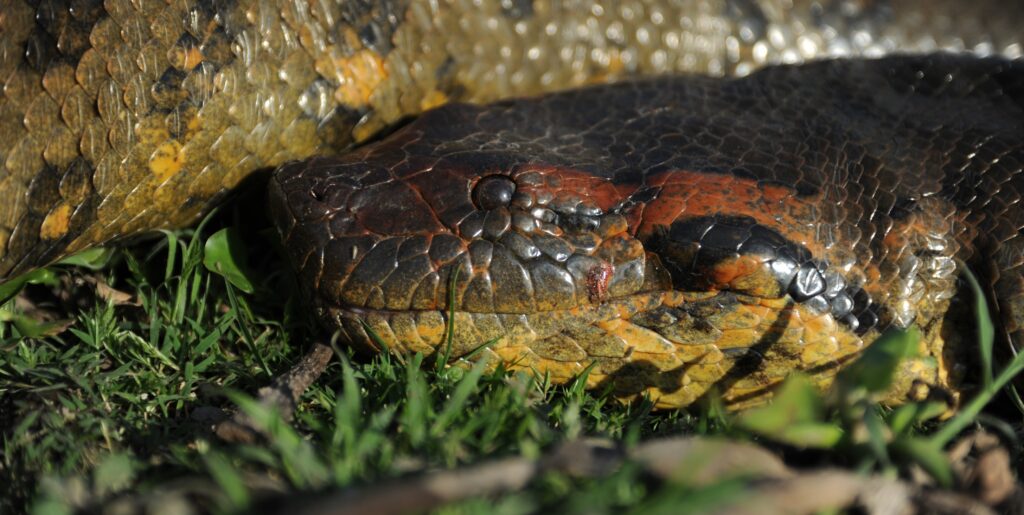
A team of scientists on site with a film crew in the remote Amazon region is found A species of anaconda that has never been documented before.
Professor Brian Fry from the University of Queensland led a team that captured and studied several specimens of the newly named northern green anaconda (Eunectes acaiima), located in the Bameno region, in the Paihuairi-Uorani region, in the Ecuadorian Amazon.
“Our team received a rare invitation from the Waorani people to explore the area and collect specimens from the anaconda population, said to be the largest ever known,” Professor Fry said.
“The indigenous hunters took us into the forest on a 10-day expedition to search for these snakes, which they consider sacred,” the researcher explains, noting that “we paddled boats through the river system and were lucky to find many anaconda snakes.” It lies in shallow water, waiting for prey.
“The size of these magnificent creatures was unbelievable – we found a female anaconda that was 6.3 meters long,” he reveals, adding that “there are anecdotal reports from the Waorani people of other anacondas in the area measuring over 7.5 metres.” It weighs about 500 kilos.”
Professor Fry said the northern green anaconda species diverged from the southern green anaconda approximately 10 million years ago, and they differed genetically by 5.5 per cent.
“It's very important – to put this into perspective, humans are only about 2% different from chimpanzees,” he explained, stressing that “this discovery is the highlight of my career.”
The new species of anaconda was found during filming with National Geographic Channel for its upcoming Disney+ series Pole to Pole with Will Smith, in which Professor Fry, a National Geographic explorer, is the scientific leader of the expedition.
“Our journey into the heart of the Amazon, facilitated by an invitation from the Waorani leader Binti Paihua, was a true cross-cultural effort,” he stated, adding that “the importance of our Waorani collaborators is recognized by the fact that they are collaborators.” The authors of the article.
Scientists also set out to compare the genetics of the green anaconda with specimens collected elsewhere by the world's leading anaconda expert, Jesus Rivas of New Mexico Highlands University, and use it as an indicator species of ecosystem health.
Professor Fry said the Amazon still faced alarming environmental threats.
“Deforestation in the Amazon Basin due to agricultural expansion has led to habitat loss of between 20 and 31 percent, which could affect up to 40 percent of its forests by 2050,” he said.
“Another growing problem is habitat degradation due to land fragmentation, driven by industrial agriculture and heavy metal pollution linked to spills from oil extraction activities,” he added, stressing that “wildfires, drought and climate change also pose notable threats.”
The professor also said that “these rare anacondas and other species that share this remote ecosystem face major challenges,” and that his next research project will focus on heavy metal pollution in the Amazon.
He added: “It is not only these giant snakes that face environmental threats, but almost all living organisms in the region,” stressing that “the discovery of a new species of anaconda is exciting, but it is necessary to emphasize the urgent need.” To further investigate these threatened species and ecosystems.
“It is particularly urgent to investigate how petrochemicals from oil spills affect the fertility and reproductive biology of these rare snakes and other keystone species in the Amazon,” he concluded.

“Hardcore alcohol maven. Hipster-friendly analyst. Introvert. Devoted social media advocate.”